KNetAI vs Dify
Dify is a lovely way to build and ship LLM apps and chatbots. KNetAI is for when the work outgrows an app — long-running, multi-system, governed agent networks. Both self-host; they aim at different problems.

Where an app builder meets an orchestration problem
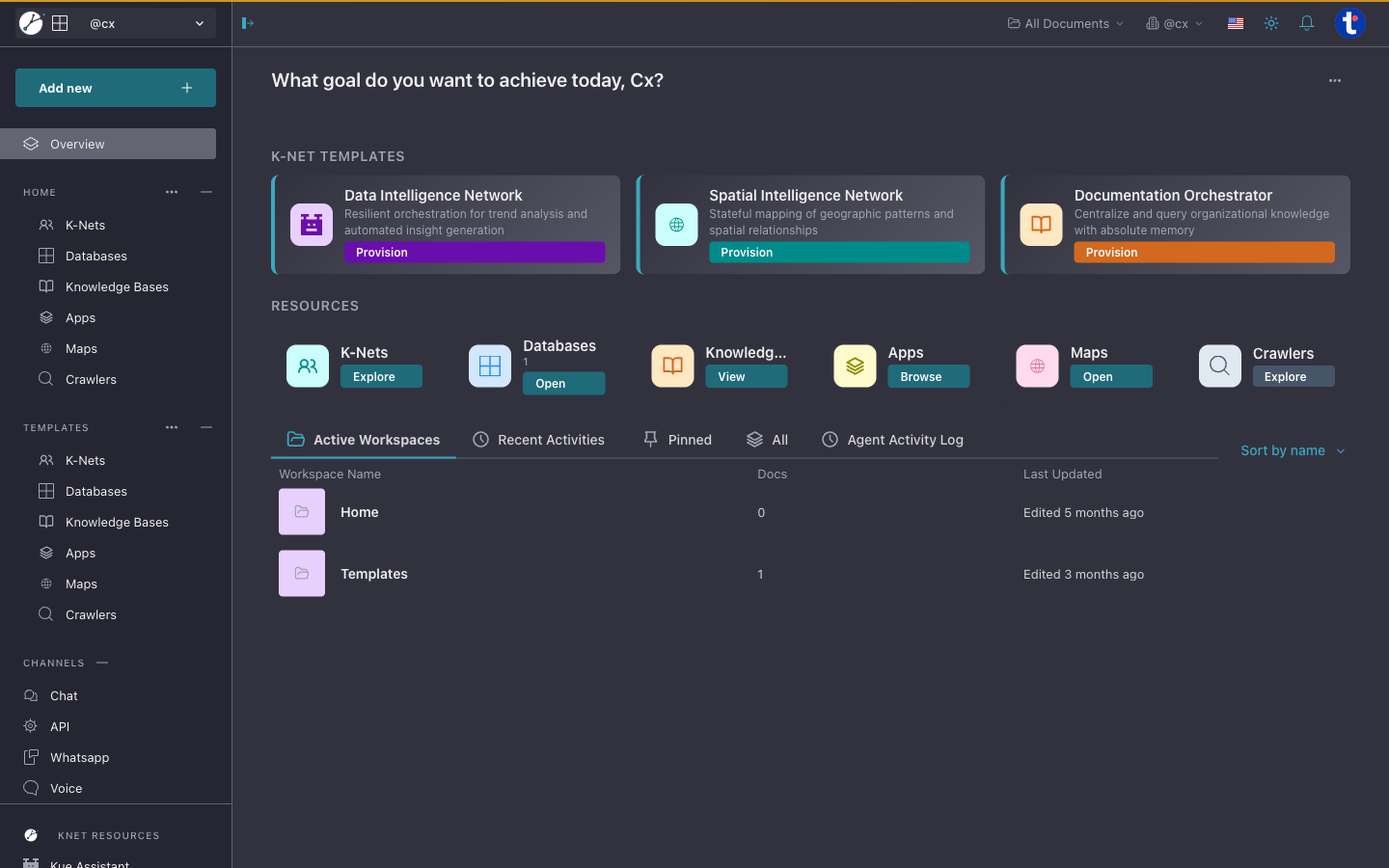
Multi-system depth: coordinating many enterprise systems over long horizons goes beyond a single app flow.
Long-running durability: processes that pause for days and resume with full state aren't the app model's strength.
Deep governance: fine-grained RBAC, audit, and human approval chains for regulated work need a platform layer.


What K-Nets add beyond an app
- K-Nets coordinate many agents, tools, humans, and enterprise systems as one durable process — where Dify centers on building individual LLM applications.
- Smart RAG offers deep embedding and sub-second retrieval across millions of documents, tuned for scale beyond a typical app knowledge base.
- RBAC, audit trails, human-in-the-loop, and resumable long-running state are part of the runtime — the requirements that turn a chatbot into infrastructure.
Where Dify genuinely shines
Dify has earned its fans, and for good reasons:
- Polished LLMOps UI. Building prompts, agents, and RAG pipelines through a clean visual interface is fast and pleasant.
- Great for chat apps. Shipping a capable chatbot or assistant is quick, with sensible defaults.
- Self-hostable & open-source. Teams can run it in their own environment with full control.
- Approachable RAG. Its built-in retrieval makes knowledge-grounded apps easy to stand up.
Where teams hit the wall
Dify's app-centric focus is its strength and its boundary:
- App, not orchestration. Coordinating many agents, humans, and enterprise systems as one long-running process goes beyond the app model.
- Durability limits. Processes that must pause for days and resume with full, replayable state aren't the sweet spot.
- Governance depth. Fine-grained RBAC, audit chains, and formal approval flows for regulated work need a platform layer.
- Scale of retrieval. Enterprise corpora in the millions of documents ask for a dedicated engine.
Ask what you're actually shipping: an app people talk to, or a process the business runs on? Dify is built for the first; KNetAI is built for the second.
Side by side
| Dify | KNetAI | |
|---|---|---|
| Primary unit | LLM app / chatbot | Durable agent network |
| Multi-system, long-running orchestration | Limited | Core capability |
| RAG | Good, app-scale | Enterprise-scale Smart RAG |
| Human-in-the-loop & approval chains | Basic | Built-in primitive |
| Governance (RBAC, audit) | Lighter | Deep, runtime-level |
| Self-hosting | Yes | Yes (VPC / air-gapped) |
| Best fit | Shipping LLM apps fast | Running mission-critical processes |
The honest verdict
Use Dify to build and ship LLM apps and chatbots quickly with a great UI — it's an excellent tool for that. Move to KNetAI when the work is no longer an app but a durable, governed, multi-system process. Many teams prototype an assistant in Dify and graduate the serious workflows onto K-Nets.
Frequently Asked Questions
Dify's agent and RAG features are genuinely good for chat apps and focused assistants. The reason to move isn't capability-per-feature — it's scope. When the work becomes a long-running, multi-system, governed process rather than an app someone chats with, you've crossed into orchestration territory.
Not at all. For building and shipping LLM apps quickly with a clean UI and self-hosting, Dify is excellent and often the right first tool. KNetAI is the next layer when those apps need to become dependable enterprise systems.
Customer-facing chatbots, internal Q&A assistants, prompt-engineering workflows, and simple agents where the deliverable is an app. Dify gets you there fast with a polished experience.

When the chatbot becomes a system
Bring the Dify app that's outgrowing its boundaries. We'll show you what durable, governed orchestration looks like on a K-Net.