DocumentationDatabases
Databases
Spreadsheet-style databases and documents for your workspace, and the home page of every workspace.
Databases (KnetDB) holds your workspace's tables and documents. Each document is a set of linked tables with formulas, views and access rules, like a spreadsheet that behaves like a database. Kue, K-Nets and Connectors read and write the same tables.
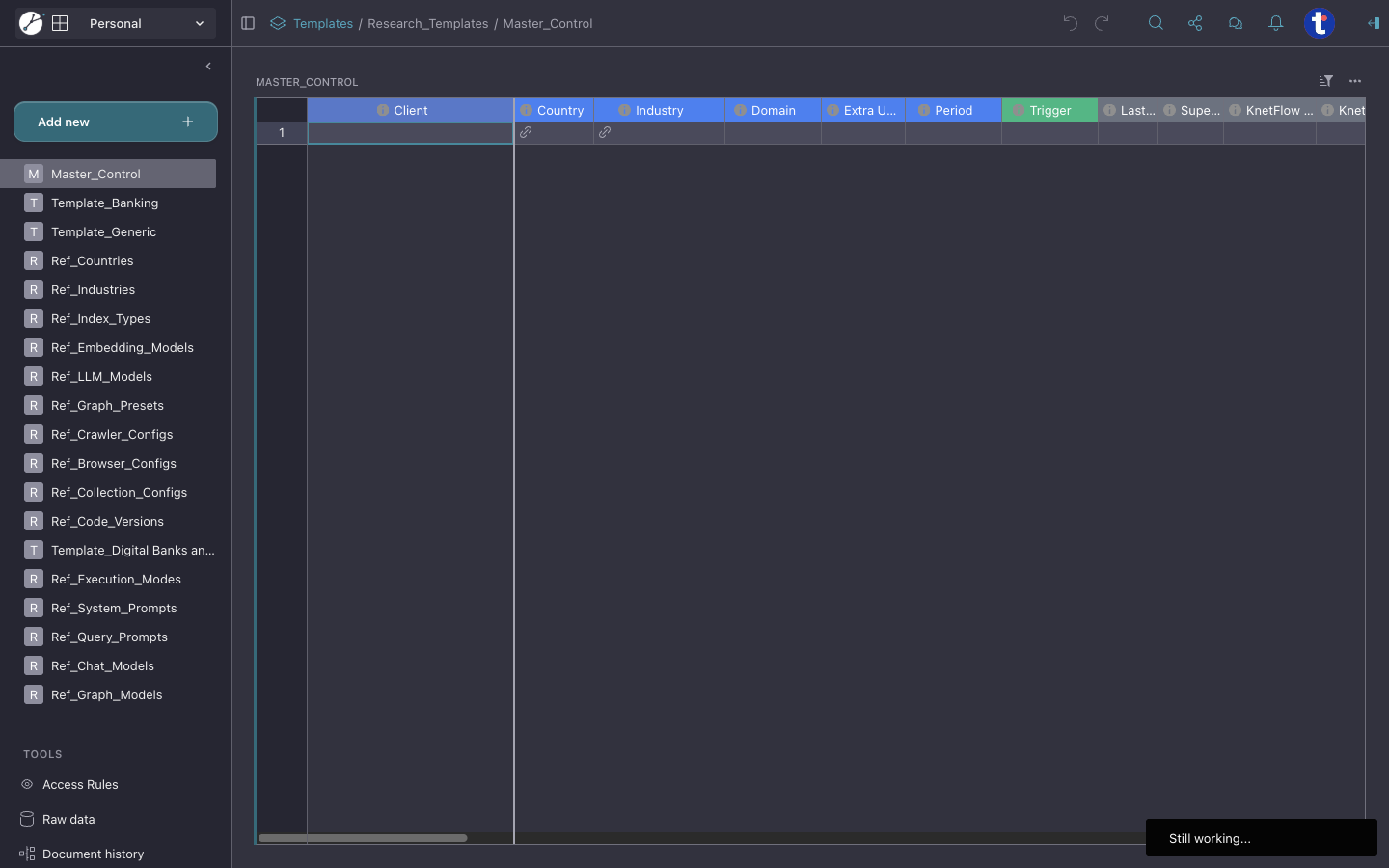
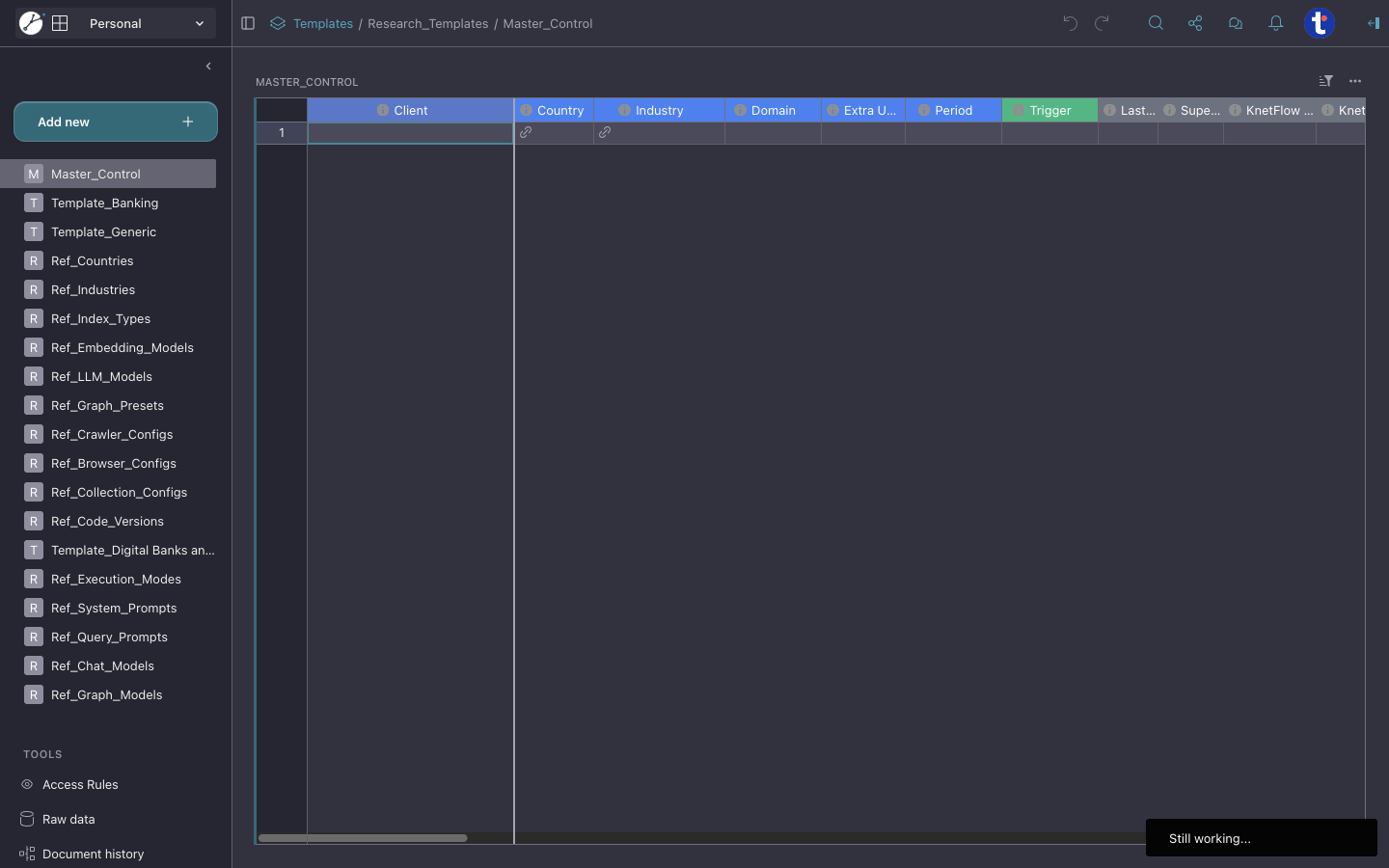
Open it from the rail in Kue, or at flow.knetai.com → your organisation → your workspace.
Document Structure & Tables
Every KnetDB document functions as a complete relational database with spreadsheet ergonomics:
- Multi-Table Architecture: Organize data into linked tables (such as
Master_Control,Template_Banking,Ref_Countries, andRef_Industries). - Typed & Reference Columns: Support for text, numeric, date, choice lists, formulas, and relational foreign keys between tables.
- Agent Triggers: Attach action triggers and status columns directly to rows, letting K-Nets and workflows react automatically to data updates.
- Access Rules & Audit: Configure row- and column-level access rules, inspect raw document schemas, and track full document edit history.
The page
- Add new creates a document, imports an external file (CSV, Excel), or creates a blank table.
- Recent Activities, All, and Pinned organize your workspace documents.
- Mission Control provides quick navigation back to the unified workspace launchpad.
The left pane lists everything in the workspace:
| Group | Pages |
|---|---|
| Your workspace | Overview (recent documents and activity), K-Nets, Databases, Knowledge Bases, Connectors, Maps, Crawlers |
| Channels | Chat (chat with agents about your data), API (API keys for this workspace), Whatsapp (connected numbers), Voice (voice agents) |
| KNet resources | Kue, Examples & Templates, Trash (restore deleted documents), Tutorial, Help Center |
Typical tasks
- Ask Kue: "Create a database of my suppliers with name, country and rating."
- Start from Examples & Templates and edit the copy.
- Share a document: open it and use Share to invite people or set access per table.